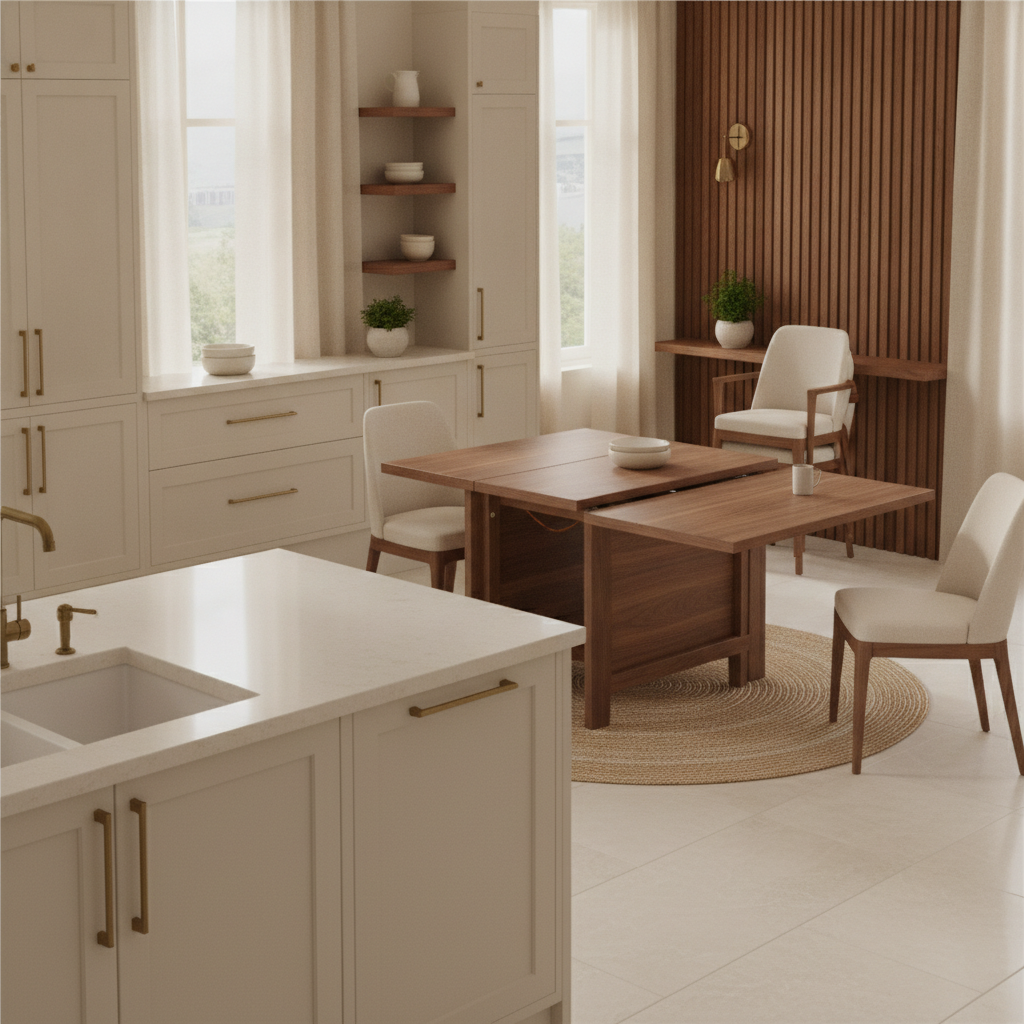
A folding dining table is a room doing two jobs, and the mechanism is the design. When it works, a studio or a small dining end can be a clear floor at noon and a table for four at seven. When it fails, the leaf sags, the gate leg lands on a rug, the wall bracket creaks, and everyone eats at the coffee table because the “dining table” feels like a prop. I trained in interior architecture, and I use early visualization to test proportion. With a folding dining table, proportion changes twice: once when the top is a narrow console against the wall, and again when it is a full table in the only path to the kitchen. Both sizes have to look like they belong to the same room.
This guide compares the mechanisms that actually show up in US apartments and small houses, how to judge stability before you buy, and how light and chairs should be planned for the open size, not the folded photograph. A room-photo planner such as Best Kitchen Design can show the open and closed mass on your walls. Confirm finishes in person. A hinge, a leg, and a top sample will tell you more than a render about whether the piece feels solid.
Pick the Mechanism Before the Finish
Name the action. “Folding” covers several machines, and they ask different things of the wall, the floor, and the person who sets dinner up alone.
A drop-leaf table has one or two hinged leaves that hang down or lift up, supported by a pull-out slide, a swing leg, or a gate leg. Closed, it often becomes a narrow table or a console, sometimes 12 to 16 inches deep, sometimes closer to 20 if the top is thick. Open, a two-leaf version can seat four to six. The hinge line is the design. It will show. On a wood top, align the grain and accept a seam. On a laminate or a lacquer, the seam still shows as a line, and it should be tight enough that a plate does not rock across it.
A gateleg is a drop-leaf whose support is a hinged leg frame that swings out like a gate. It is stable when the gate opens fully and locks, and it is a shin-catcher when the gate sits where a person wants to put a knee. Look at the open position from the chair’s point of view, not from the front of the catalog. If the gate crosses the center of a place setting, you will eat sideways forever.
A wall-mounted folding dining table pivots down from the wall on brackets or on a continuous hinge, and it may have a leg that swings down at the outer edge. Closed, it can be as thin as a few inches of panel, or it can look like a shallow shelf. This is the right idea when the floor must be completely clear for a sofa bed, a yoga mat, or a child who uses the whole room. It requires structure in the wall. Brackets into drywall alone are not a plan. You need studs, or solid blocking installed before the paint, and a bracket rating that covers the top plus a person who will lean on it, because someone will lean. A cantilever with no outer leg can work for a narrow breakfast bar. For a table that seats four, I want at least one firm leg at the outside edge.
A butterfly or expanding console opens by unfolding leaves that were stored inside, sometimes with a metal frame that scissors outward. Closed, it is a hall table. Open, it may seat four or six. The quality is entirely in the frame. A light frame will rack when two people rest their elbows on opposite leaves. Operate it. Lean on the far corner. If the top twists, the apartment is telling you to keep looking.
An extension table with a leaf in the apron is only partly a folding dining table, and it is often the most stable of the group because the everyday top is a real four-leg or pedestal table. You add one or two leaves when guests come. Choose it when you have a dining area every day and only sometimes need eight seats. Choose a wall-mounted or drop-leaf piece when you do not have that everyday floor.
A folding trestle and a separate top — a top that lifts off and stores in a closet, legs that fold flat — suits a household that hosts rarely and has a closet that can take a 30-inch-wide panel. It is a two-person setup. If you imagine yourself moving a stone or a heavy oak top alone on a weeknight, you will not do it, and the folding dining table will live in its open state in the way.
| Type | Closed footprint | Seats when open | Demand on the room |
|---|---|---|---|
| Wall-mounted, with an outer leg | A few inches to about 10 inches off the wall | 2 to 4, sometimes 6 if long | Studs or blocking, bracket rating, clear floor for chairs |
| Drop-leaf, one leaf | Often 12 to 20 inches deep | 2 to 4 | Hinge quality, support that misses the knee |
| Gateleg, two leaves | Similar narrow console | 4 to 6 | Floor space for the gate to swing, rug clearance |
| Butterfly / expanding console | Hall-table depth | 4 to 6 | Frame that does not rack, a place to stand while opening |
| Apron leaf extension | A full small table | Adds 1 or 2 per leaf | Storage if the leaf is not in the apron |
| Removable top and trestle | Top stored flat | 4 to 8 | Closet depth, two people to move a heavy top |
Renters should read the wall column twice. If you cannot open the wall to add blocking, a wall-mounted folding dining table is a poor bet unless the studs land exactly where the bracket holes land and the lease allows the screws. A freestanding drop-leaf or a small extension table leaves the plaster intact. Command strips are not a structural system. Neither is a single stud with a long top cantilevered to one side. The mount should be centered on structure, and the closed panel should not cover a thermostat, a switch, or the only return vent.
Stability, Clearance, and a Setup You Will Actually Do
Stability is a test you perform, not a promise in the product title. In the showroom, or on delivery day, do these things. Open the leaf all the way. Sit on the outer corner, carefully, or at least lean your full forearm and some weight there. The top should not slope like a ramp. Pull the support leg back a half inch and see if a lock stops it. Rock the table from the end. A little flex in a long wood top is normal. A wobble at the hinge or a knock in the bracket is not. Lift a glass at the leaf and look at the water surface while someone writes with pressure on the other side. If the surface shivers, the frame is light for the job.
Leg location is comfort. A drop-leaf support that lands in the middle of a place setting will bruise a knee and will train everyone to sit too far back, which means spilled food. Ask for a support offset to the ends, or a slide support tucked under the top so the knee zone stays clear. On a wall-mounted table, the outer leg should be inset from the corners enough to let an end chair slide, and it should miss the center of the long side. Height wants to finish at 29 to 30 inches, the same as any dining table. A wall bracket that cannot be adjusted will settle into a slope if the floor is out of level, which old apartments are. Shims at the leg, or a bracket with a small adjustment, are part of a grown-up install.
Clearance has to be drawn in the open position. A folding dining table that seats four needs the same chair pull-out as a permanent table: about 36 inches from the open edge to the nearest wall or sofa so a person can sit, and a path of 36 inches or more if someone must walk past. The mistake is measuring the closed console, buying the sofa that fits that prettier floor, and then discovering the open leaf lands on the sofa arm. Tape the open footprint on the floor for a week. Eat one dinner inside the tape, even if the table has not arrived. You will learn whether the leaf blocks the fridge, the balcony door, or the only lamp.
Chairs are the second storage problem. A folding dining table that disappears and four chairs that remain in a cluster has only solved half the room. Options that work: chairs that stack two high in a closet, folding chairs that are better than the banquet kind — solid seats, a height near 18 inches, a weight you can carry — or a bench that tucks under the closed console. A bench stored under a wall-mounted table is a classic pair, and the bench must be shorter than the closed table’s clear height. Measure that gap. Stools that slide under a closed drop-leaf look tidy and sit badly for a long meal. If dinner is short, stools are honest. If dinner is the main event, use real chairs and give them a home that is not the fire escape.
Setup time decides whether the table folds. If opening the table takes two people, three latches, and a rug relocation, it will stay open and the room will stay cramped, or it will stay closed and you will eat on the couch. Prefer a mechanism one person can run in under a minute, with a support that locks without a tool. Keep the daily setting for two as the easy position. The six-person position can be slower. Protect the floor: felt or a proper glide on every leg that moves, because a gateleg swung across white oak will write an arc into the finish. If you have a rug, the leg must land flat on the rug or the rug must stop before the leg. A leg on the edge of a rug is a rock.
Weight belongs in the specification. A light honeycomb top is easy to fold and feels like a catering table once the plates are down. A solid wood or a plywood top with a real veneer weighs more and sounds better under a plate. Stone and sintered tops can be beautiful and are rarely a one-person fold; they make more sense on an extension table that stays put than on a wall-mounted panel. Match the top weight to the bracket rating with a margin. A manufacturer’s “holds 80 pounds” is not an invitation to seat a person on the edge of a cantilever.
Hardware finish should agree with the kitchen or the window metal, because the hinges will be visible when the leaf is down. A stainless piano hinge on a walnut console is a shop detail. A black hinge on a pale oak top is a stripe. You can make the stripe intentional. You cannot hide it with a runner when the leaf is folded and the hinge faces the room. Ask to see the folded position in the finish you are buying, not in a default oak on the website.
Proportion, Light, and the Two Rooms You Own
A folding dining table has two elevations, and both should be designed. Closed, a wall-mounted panel should look like a shallow cabinet, a framed panel, or a console with a purpose — a lamp, a tray — not like a bare board screwed to the drywall. Give it a top surface deep enough for a set of keys if it is also the entry, and a lip or a tray so those keys do not slide off when the panel is vertical. Some wall tables fold up and present a finished back. That back is a wall composition. Paint it the wall color if you want it quiet, or make it a single panel of the same wood as the floor so it reads as furniture. A raw MDF back with visible cam locks is what makes a small room feel temporary.
Open, the table should sit in a pool of light planned for that larger rectangle. A pendant centered on the closed console will be off-center once the leaf opens toward the room, and everyone will notice it on the first dinner. Center the light on the open table, or use a light that can slide on a track a short distance between the two centers. If you cannot move the junction box, choose a slightly wider linear fixture that covers both centers well enough, or accept a floor lamp at the open end and keep the ceiling light as general ambient. Hang pendants so seated people can see each other, typically with the bottom of the shade well above eye level when seated, often in the low 30 inches above a 30-inch table. A folding dining table does not need a smaller, sadder light than a permanent one. It needs a light that knows which size is dinner.
Circulation when the table is closed is the gift of this furniture. The room should regain a clear path, a place for a stroller, or the full opening of a sofa bed. If a folded leaf still projects 18 inches into a 36-inch hall, you bought a semi-folded obstacle. Wall-mounted tables win here. Drop-leaf tables that remain on four legs still occupy a footprint; they only get narrower. Put that remaining footprint against a wall or in a niche, not in the center of a tight room where the closed table is still a hip check.
Style should be one system with the rest of the apartment. A modern folding dining table with a thin oak top, a pale lacquer, or a linoleum work surface — the material some European tables still use because it is quiet and repairable — will sit well with flat cabinet doors and a simple chair. A heavy turned leg on a “traditional” gateleg will fight a modern kitchen in the same glance. You do not have to match species exactly. You do have to match weight. A dainty gold-legged console that expands into a six-top will look like two products. Prefer one wood, one metal, and a top thickness you have touched.
Acoustics change when the table opens. A hard top close to a hard floor in a small room gets loud. A thin wool runner you can remove and wash, or felt pads under a center platter, will calm it. Do not rely on a thick shag under a gateleg; the leg will not sit true. If the table is also the desk, give the work a tray that lifts off so dinner is not a shutdown ritual of cables. A single drawer in a freestanding drop-leaf is worth more than a wireless charger inlay that fails in two years.
If you are unsure whether the open leaf blocks the kitchen path, model both positions. Upload a straight photo of the room to Best Kitchen Design and use it as a room-photo planner for the open table versus the closed console, including the chairs. Then confirm finishes in person: open a sample hinge, feel the top, and check the color against the cabinet door at night. Buy the mechanism you can operate on a tired Thursday. The finish is the easy part once the leaf stays level and the chairs have somewhere to go.
A Short Buying Sequence
Measure the open rectangle and the closed depth, and tape both. Locate studs if the table hangs on the wall, and sketch the bracket line at the height that yields a 29- to 30-inch top. Count chairs and name their storage. Check the door swings of the fridge, the closet, and the entry while the tape is on the floor. Only then choose wood, laminate, or a coated top, in a color that agrees with the floor you already have.
Read the warranty on the mechanism, not only on the finish. Hinges and slides fail first. Ask what part is replaceable when a lock wears out, because a folding dining table is a moving object and moving objects need parts. If the seller cannot describe the support in a sentence — gate, slide, or bracket and leg — you are looking at a picture, not a table.
Set it up the day it arrives and eat at it that night, both at the two-person size and at the full size if you can. You will learn whether the light is centered, whether the leg hits the rug, and whether the folded panel looks intentional from the sofa. Adjust the foot, move the bench, and decide. A folding dining table that passes that evening will keep a small home honest: one room, two footprints, and a dinner that does not require a contractor.
FAQ
Which folding dining table is most stable?
An everyday table with a leaf stored in the apron is usually the most stable, because the main top never hinges. Among true fold-down pieces, a gateleg or drop-leaf with a locking support at the ends, or a wall-mounted top with a firm outer leg into blocked framing, beats a light cantilever. Lean on the open corner before you buy. If it racks, keep looking.
Can I mount a folding table on a rental wall?
Only if the lease allows screws into studs and the studs line up with a bracket that can carry the top. Drywall anchors are not enough for a dining surface people will lean on. If you cannot attach to structure, use a freestanding drop-leaf or extension table and leave the wall alone.
How much floor space does an open folding table need?
Plan the open size plus about 36 inches to pull out chairs on the sides where people sit. Also leave a walking path, especially to the kitchen, of at least 36 inches. Tape the open footprint before you buy a sofa that only fits when the leaf is down.
How do I store chairs for a table that folds away?
Stack two solid chairs in a closet, use a bench that slides under the closed table, or keep folding chairs with a real seat height near 18 inches. The table is only half the clearance. Four chairs left in the middle of the room cancel the fold.
What height should a wall-mounted dining table be?
The top should land at about 29 to 30 inches, the same as a standard dining table, with chairs or a bench near 18 inches at the seat. Set the bracket from the finished floor, and expect to shim if the floor slopes. A breakfast bar can sit higher, near counter height, if you are using stools and you mean a shorter meal.
Do folding tables work as a daily desk and a dinner table?
They can, if the work lives on a tray that clears in one move and the cables have a home that is not across the top. Use the two-person or closed-to-desk position for the workday, and make the dinner position a single gesture. If changing modes takes five minutes of sorting mail, the table will stay in one mode and the room will not.