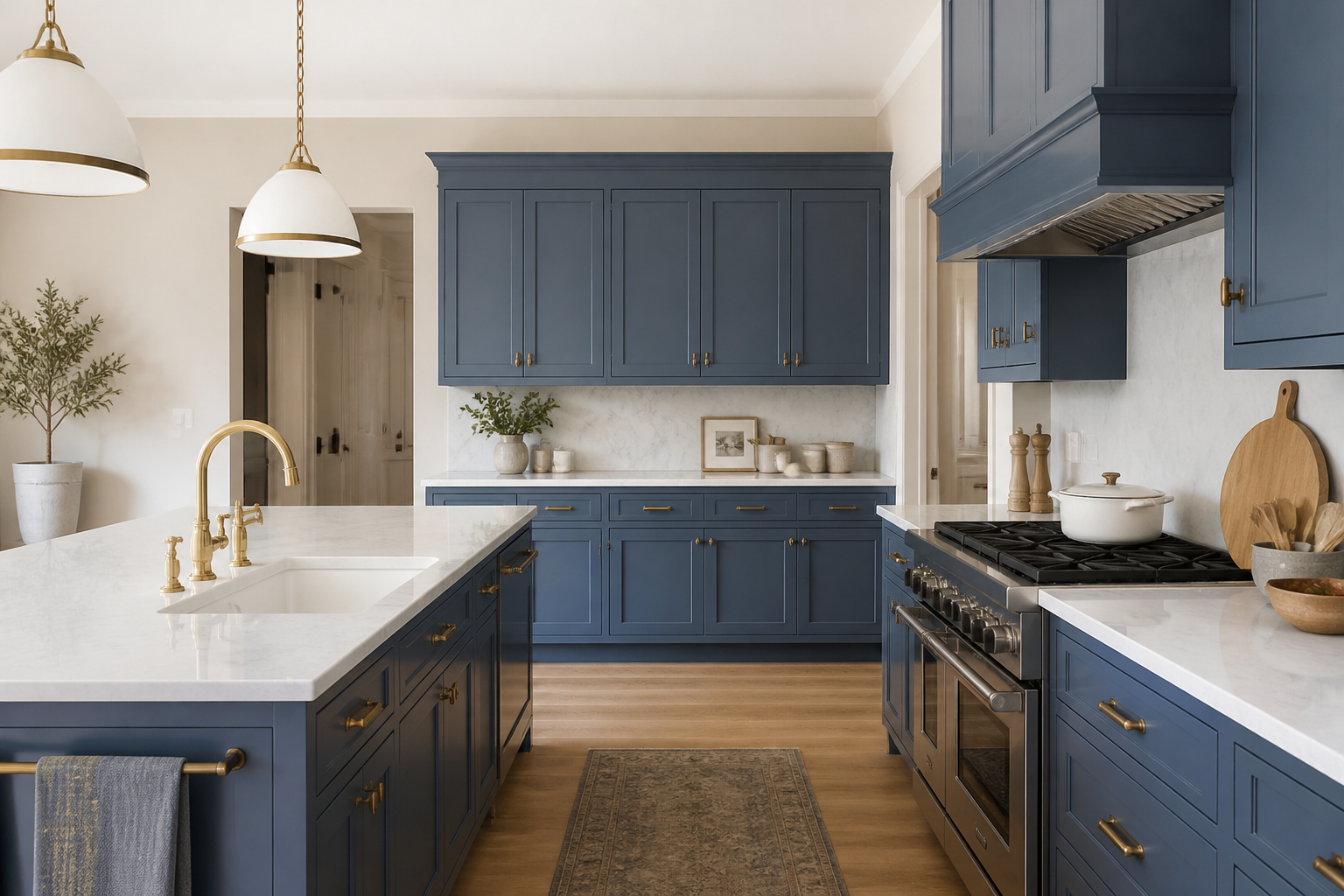
Blue kitchen cabinets fail when someone orders “blue” the way they order “white.” Blue is a family: navy that behaves like a dark neutral, dusty blue that sits next to oak, teal that leans green, periwinkle that goes pastel in afternoon sun, and a bright builder blue that will date like hunter green from a previous cycle. The door style, the sheen, and the neighboring wood decide whether blue reads as considered kitchen cabinet design or as a sports-team kitchen.
I specify cabinets and finishes. When a client wants blue, I want a chip on the actual door profile, in their north light, next to their floor. This guide is how to pick a blue you can live with, how to pair it, and how to write the shop ticket so you do not get a surprise purple under LED cans.
A photo overlay helps you test navy versus dusty blue on your walls — Best Kitchen Design is an easy way to do that — but pigment is physical. Borrow a door.
Choosing a Blue That Belongs in the House
Start with the job of the color, not the name on a trendy palette.
Navy and inky blues act like black with more air. They are the safest whole-kitchen blues if you have decent light. They hide some wear, they sit next to brass and walnut, and they photograph as luxury without requiring black’s severity. Navy on a chunky traditional door is heavy; navy on a slim shaker or a slab is millwork.
Dusty, gray, or clay blues are the livable mid-tones. They are kinder in rooms with warm oak floors. They can look dingy if the lighting is cool and the grout is dirty-gray, or chalky if the sheen is too flat. These blues are where most “soft blue shaker kitchen” pictures live. Sample them at night. Many go gray or lavender after dark.
Teal and blue-green connect to plants, to copper, to older craftsman tile. They are less generic than powder blue and more personal than navy. They fight some gray quartzes hard. Pair them with cream, unlacquered brass, and wood, not with cool stainless everything unless you like a laboratory teal.
Light and pastel blues bounce light and can feel coastal or nursery, depending on the rest of the kitchen styles in the house. A pale blue slab kitchen in a sunny room can be beautiful. The same color in a basement kitchen can look unfinished. Pastels show scuffs the way white does.
Saturated bright blues are a commitment. I use them on an island, a pantry, or a butler’s pantry more than on every upper in an open great room. A bright blue perimeter will own every adjacent beige wall. If the house is already colorful, it can sing. If the house is a quiet rental-beige open plan, the kitchen will look like a popup.
Undertone is the whole game. Put the door next to your floor, your stainless, and a white sheet of paper. If the blue goes purple, your LEDs or your stone are pulling it. If it goes green, your yellow oak is pulling it — sometimes that is handsome. Name the undertone on the order: “blue with a gray cast, no violet.” Shops have formulas. Give them a target.
Sheen: satin is the everyday hero again. Dead flat chalky blue scuffs on rails. High gloss blue is a boat. Factory paint is more even than a site-sprayed “close enough.” Grain will telegraph through blue on oak; if you want a smooth blue, you want a smooth substrate (MDF or a tight maple).
Two-tone is how most families should meet blue kitchen cabinets. Blue island, painted or wood perimeter. Blue bases, light uppers. Blue pantry wall, quiet elsewhere. Full-blue rooms can work — I have specified them — but they need a lighting plan and a counter that stays visible.
Pairing Blue With Stone, Wood, Metal, and Floor
Kitchen cabinet design is always a group portrait.
Wood: White oak and blue is a current, calm pair. Walnut and navy is richer. Honey or orange oak needs a dusty or green-leaning blue, or a floor refinish, or a rug you actually like. Mixing leftover cherry with a cool blue is a fight. Pick one wood and repeat it on a hood, a stool, or a board.
Counters: Cream, lightly warm white, and soft taupe stones keep blue from going icy. Cool gray slabs can look corporate next to navy. Marble with warmth in the vein is lovely on a navy island. Butcher block on a blue base is a working kitchen, not a showroom, which I mean as praise. Dark counters on dark navy hide the work edge; add task light and maybe a wood section if you cook hard.
Metals: Brass is the obvious warmth. It looks intentional on navy and on dusty blue. Nickel and chrome stay crisp with cooler blues and coastal kitchen styles. Black metal can modernize blue shaker; use it as an accent, not as a fourth dark with navy doors, black windows, and black stools unless you want a very graphic room. Stainless on the range is fine; do not add three more stainless boxes if you are trying to keep the blue calm.
Tile: Handmade whites and creams let the cabinets be the color. A patterned tile plus patterned blue plus patterned stone is a parade. If you want a patterned splash, quiet the slab. If you want a slab splash, you can play a little on stools or a runner.
Floors: Light wood and pale stone-look porcelain are easy. Terracotta with blue-green can look old-world and good. Blue-gray luxury vinyl plus blue cabinets is a lot of blue-gray. Break it with a rug or a wood island top.
Walls: A warm white or a soft clay lets blue cabinets be the object. Painting walls the same blue as the doors can look custom in a closed kitchen with good trim; in an open plan it can flood the living room. Sample a large swatch on the wall that faces the sofa.
Hardware scale: Blue does not change pull size. Wide drawers still want a long pull or two cup pulls. A tiny knob on a navy pantry is timid. Cup pulls on a dusty blue shaker kitchen remain one of the most reliable kitchen cabinet design moves I specify.
Appliances: a paneled fridge in the same blue is a luxury line. A paneled fridge in wood next to blue bases is a furniture line. Stainless is honest. What looks accidental is a black glass fridge in a pale blue coastal kitchen with chrome. Align the appliance story with the metal story.
Light, Door Style, and How Blue Ages
Blue is sensitive to light temperature. Cool daylight LEDs will push some blues toward gray-violet. Warm bulbs will push teal toward green and navy toward black. Pick one bulb family for the kitchen and the adjacent room. Dim. Under-cabinet light on blue lower cabinets should be even; spotted tape makes the door look blotchy.
Natural light: a north room can take a slightly warmer, dirtier blue so it does not go steel. A west room will cook a bright blue in late day — sometimes gorgeous, sometimes loud. Stand in the room at the ugly hour, not only at noon.
Door style changes the decade. Blue shaker is the American default and it can look farmhouse, coastal, or tailored depending on rail width and hardware. Blue slab is more architectural and more fingerprint-honest. Blue inset is furniture. Raised-panel blue can look colonial or dated; it depends on the profile and the rest of the house. Match the door language to the house, then apply blue. Do not use blue to hide a door you do not like. Color does not erase a heavy ogee.
Aging: mid dusty blues and navies age more quietly than a saturated cornflower. If you are worried about resale, put the braver blue on the island and keep the perimeter in a broader-appeal paint or wood. Buyers can live with an island. They sometimes mentally price a whole blue envelope as “a repaint.” That is not a reason to be cowardly if you plan to stay. It is a reason to be honest about your timeline.
Wear: mid blues hide some fingerprints better than black and some tomato sauce better than white. Edges still chip. Keep a touch-up from the same batch. Grease on uppers is still a hood problem.
Open shelves in a blue kitchen should be wood or a related paint, and short. A long run of open blue boxes with mismatched mugs undoes the specification.
If you like coastal kitchen styles, blue is not an excuse for driftwood kitsch on every surface. Pick the blue, pick one wood, pick a simple tile, and stop. If you like a more European painted-kitchen look, a dirtier blue with brass and a plaster hood will get you there without a theme park.
Specifying Blue So the Shop Builds the Right Door
Write the color like a specifier: brand and formula if you have it, or a physical sample the shop will color-match, plus sheen, plus “no strong violet.” If the shop uses their own paint system, have them spray a door in your light, not only a chip.
Specify the substrate for the look you want. Smooth blue wants MDF or maple. Oak under blue will show grain; that can be a craftsman choice if you own it.
Specify where blue lives: all boxes, island only, bases only. Pricing and lead time change when you split colors. Ask about sheen matching between the two paints if the perimeter is white or cream — whites and blues from different systems can look like different projects.
Hardware finish and faucet should be in the room when you sign the blue. I have seen a perfect dusty blue ruined by a cheap cool chrome set that was ordered later from a different mood.
Visualize two blues and a two-tone on your real photo at Best Kitchen Design so you can see mass from the living room. Then put the winning door in the kitchen for a week if the shop will let you. Live with it through trash night and homework.
Coordinate kitchen styles across adjacent rooms. A blue kitchen opening to an orange-oak living room needs a plan: refinish, rug, or a blue that can shake hands with the oak. A blue kitchen opening to a gray-beige builder living room may want a warmer blue so the kitchen does not look like the only designed room — or it may want you to extend a little of that blue into stools, a lamp, or a frame so the open plan feels intended.
Lead times for painted custom colors can be longer than stock whites. Do not demo on a hope. Confirm the formula after the sample door, not before.
If you take one habit from this guide: never approve a blue from a phone photo of a sample. Phones love to make blue go teal or purple. Your eye in the room is the instrument.
Frequently Asked Questions
What color blue is safest for kitchen cabinets?
Navy and muted dusty blues are the easiest to live with and to pair with wood. Bright and pastel blues want more light and more commitment. “Safest” still requires a sample in your room; undertones shift beside oak and quartz.
Do blue kitchen cabinets hurt resale?
A full saturated envelope can narrow the buyer pool; a navy or dusty blue island rarely does. If you will stay for years, pick the blue you want and keep the rest of the kitchen cabinet design high quality. Paint is not the only thing buyers see. They also see cheap boxes.
What hardware looks best on blue cabinets?
Brass warms most blues. Nickel stays crisp on cooler blues. Black can modernize shaker. Match scale to the door and relate the faucet. Hardware will change the kitchen style more than a slightly different navy.
Should uppers and lowers both be blue?
Not by default. Blue bases or a blue island with lighter uppers keeps the room from sinking. Full blue works in brighter rooms with a light counter and a real lighting plan. Choose based on windows, not a saved photo of a different house.
Can I get blue kitchen cabinets in a modern slab door?
Yes. Blue slabs look architectural if the finish is factory-smooth and the lighting is even. They show fingerprints more than a mid-tone shaker. Modern and painted-furniture kitchen styles can both wear blue; the door profile is the fork, not the pigment.
Test Blue Cabinets on Your Kitchen Photo
Blue is the finish most likely to surprise you at 6 p.m. Upload a photo at bestkitchendesign.com/create and compare navy, dusty blue, and a two-tone island before you lock a paint formula.
Polar runs the subscriptions: Mini $14, Personal $18, Premium $36 a month. Details are on pricing. Use the images to short-list, then spend money on a sprayed door in your light — that is kitchen cabinet design, not a hex code.